
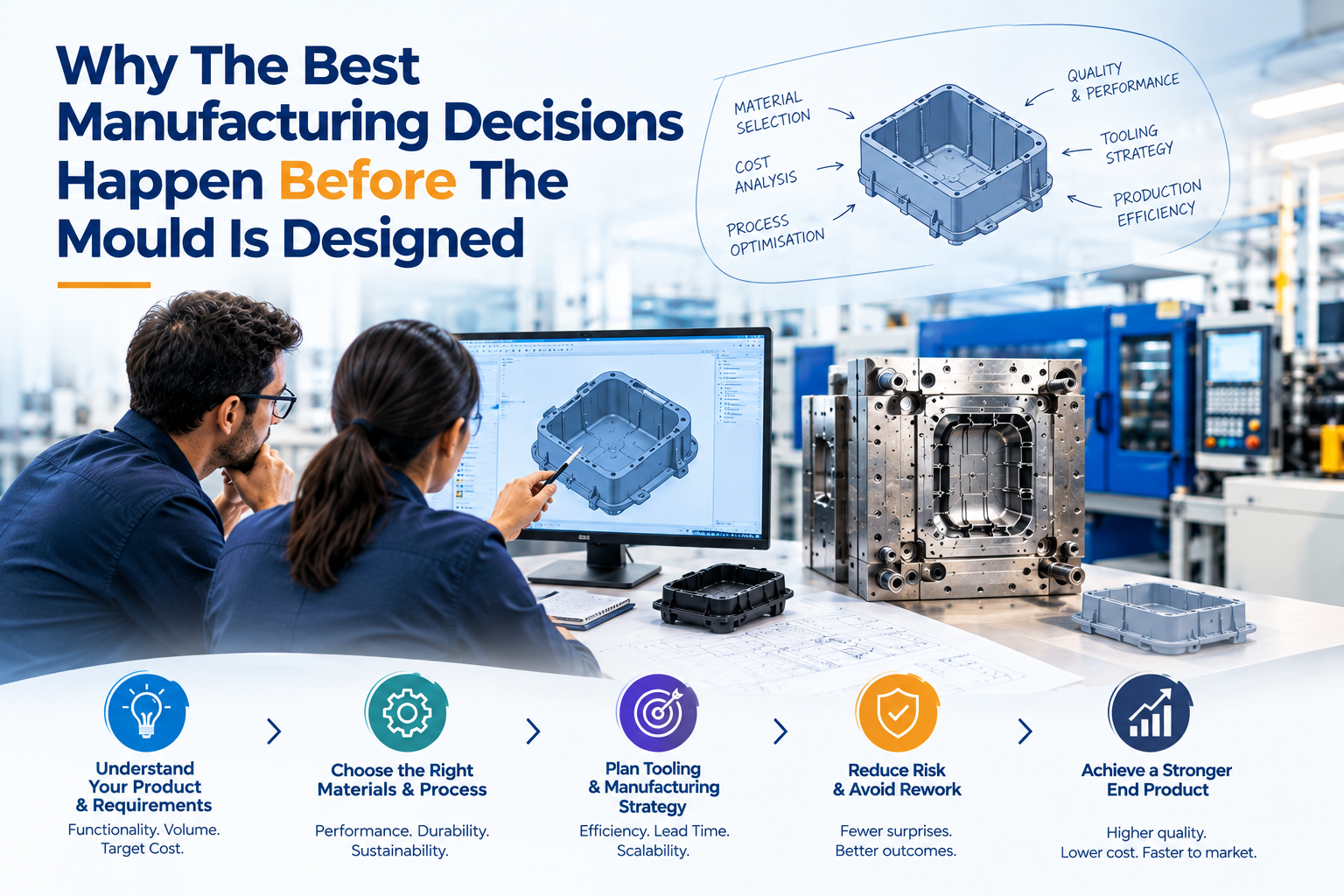
In injection moulding, the mould often gets the most attention. It is the tool that shapes the final component, so it is easy to assume that manufacturing begins when mould development begins.
In reality, some of the most important manufacturing decisions are made much earlier.
Before steel is cut, before tooling begins, and before the first trial shot is produced, decisions around product design, material, functionality, tolerances, manufacturability and assembly can significantly influence the final outcome.
This is where Atharva Polyplast believes engineering makes the difference.
For modern OEMs, Atharva Polyplast takes an engineering-led approach that considers manufacturing requirements from the early stages of product development.
A Mould Can Only Work With The Design It Is Given
A well-designed mould cannot completely compensate for a product design that was difficult to manufacture in the first place.
Features such as wall thickness, ribs, bosses, draft angles, undercuts, gate locations and tolerances can all affect how efficiently a component can be moulded.
For example, inconsistent wall thickness may contribute to warpage or sink marks. Insufficient draft can make ejection difficult. Poorly positioned gates can affect appearance, filling and part performance.
These issues may not always be obvious when looking at a finished CAD model.
That is why Design For Manufacturing (DFM) should happen before tooling begins.
At Atharva Polyplast, early engineering consideration can help identify potential moulding challenges before they become expensive tooling or production problems.
DFM Turns A Product Design Into A Manufacturing-Ready Design
DFM is not simply about asking, “Can this component be moulded?”
It is about asking:
“Can this component be moulded consistently, efficiently and at the required quality?”
A strong DFM review considers the relationship between the product design and the manufacturing process.
It can identify potential issues early, when they are still relatively easy and cost-effective to address.
Instead of discovering a problem after the mould has been manufactured, engineers can work with the customer during the development stage to evaluate:
- Wall thickness and uniformity
- Draft requirements
- Ribs and bosses
- Parting lines
- Gate and runner locations
- Ejection strategy
- Material behaviour
- Shrinkage considerations
- Critical dimensions and tolerances
- Assembly requirements
The earlier these decisions are made, the more opportunities there are to improve the final product.
For OEM projects, Atharva Polyplast can bring manufacturing knowledge into these early discussions, helping connect product requirements with injection moulding considerations.
Good moulding begins with good engineering.
Material Selection Is An Engineering Decision
The right polymer is not simply the material that meets a specification on paper.
Material selection needs to consider the product’s actual application and manufacturing requirements.
Depending on the component, engineers may need to evaluate factors such as:
- Strength and stiffness
- Impact resistance
- Temperature exposure
- Chemical resistance
- Dimensional stability
- Surface finish
- Wear requirements
- Environmental conditions
- Processing characteristics
A material that performs well in one application may not be the right choice for another.
That is why material selection should happen as part of the product-development conversation—not as an isolated manufacturing decision.
At Atharva Polyplast, material selection can be considered alongside component design, application requirements and injection moulding conditions.
Material characteristics can influence shrinkage, processing behaviour, tooling requirements, cycle time and final component performance.
This makes material selection an important engineering discussion rather than simply a purchasing decision.
Tooling Should Follow Engineering, Not Lead It
Once the product design and manufacturing approach are properly evaluated, tooling becomes much more purposeful.
The mould is designed around decisions that have already been considered:
Product requirement → DFM → Material → Tooling strategy
This approach can help reduce avoidable tooling modifications and improve the chances of achieving the required component quality from the early trials.
It also creates better alignment between the customer, product-development team, toolmaker and manufacturing team.
For Atharva Polyplast, tooling is an important part of the overall engineering and injection moulding process.
A tooling strategy should consider component geometry, material behaviour, expected production volumes, cycle requirements and quality expectations.
This helps create a clearer path from product design to repeatable production.
The Cost Of Making Decisions Too Late
One of the biggest challenges in product development is that the cost of change usually increases as the project progresses.
A design change during the concept or DFM stage may be relatively straightforward.
The same change after tooling has been completed can involve:
- Tool modifications
- Additional trials
- Delayed production
- Additional validation
- Increased development costs
- Changes to downstream processes
This is why engineering involvement before tooling isn’t just about technical optimisation.
It is also about reducing risk.
For OEMs, involving Atharva Polyplast during the early stages creates an opportunity to discuss manufacturability before major tooling and production investments are made.
Early collaboration cannot eliminate every manufacturing challenge, but it can help identify avoidable issues before they become more difficult and expensive to address.
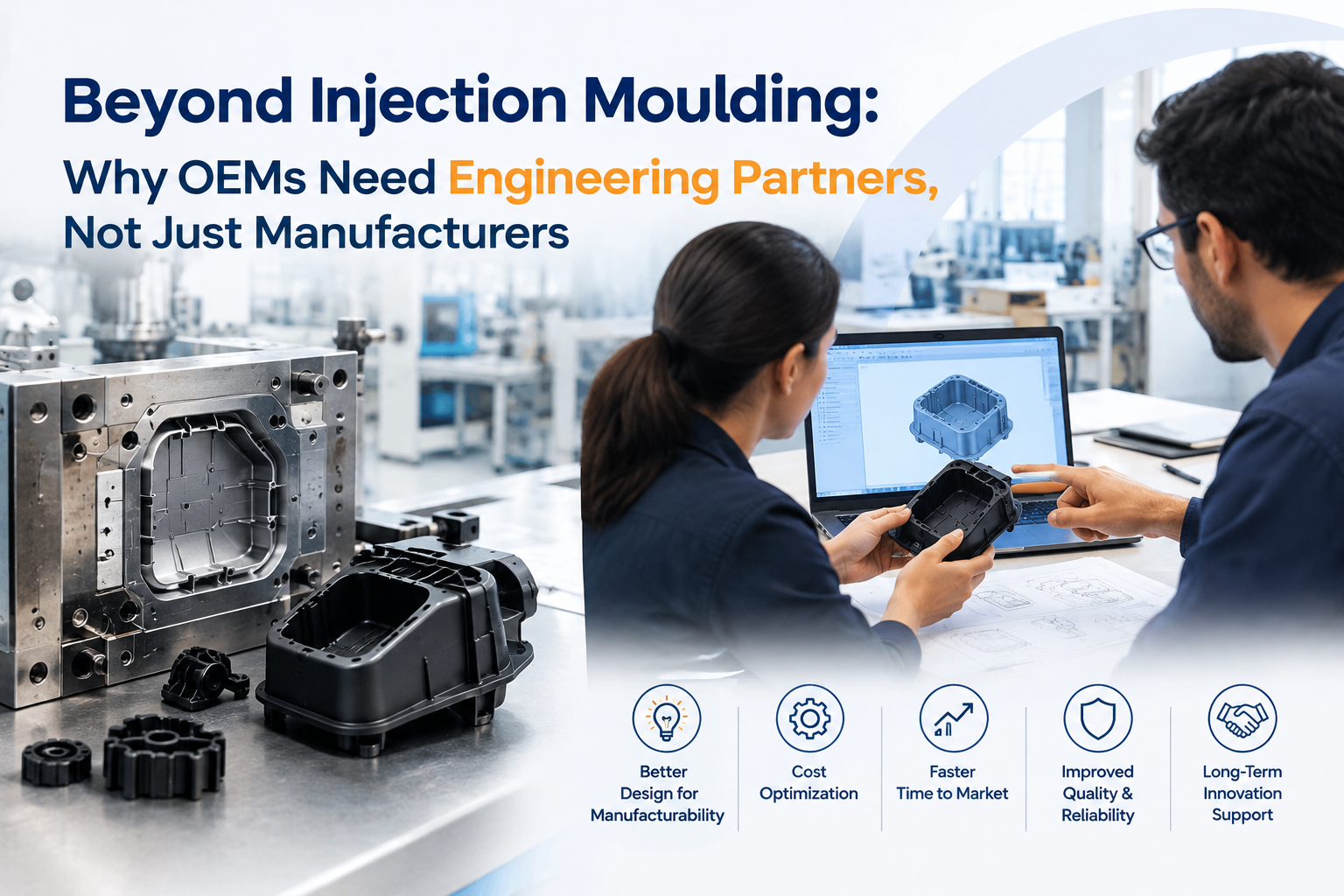
From Component Manufacturer To Engineering Partner
For OEMs, the value of a manufacturing partner goes beyond producing parts to specification.
A stronger partnership begins when the manufacturer can contribute engineering knowledge before the mould is even designed.
At Atharva Polyplast, the product journey can be viewed as a connected process:
Concept → DFM → Material → Tooling → Prototype → Validation → Production → Assembly
Each stage influences the next.
When these stages are considered together, manufacturing becomes more than simply converting a drawing into a component. It becomes a collaborative engineering process focused on building a product that can perform reliably in the real world.
This is the approach Atharva Polyplast is working toward with OEM customers—combining injection moulding capabilities with engineering thinking and manufacturing experience.
Why Early Engineering Collaboration Matters
When manufacturers are involved only after the product design is complete, many important decisions may already be fixed.
Early collaboration creates more opportunities to evaluate:
- Design manufacturability
- Material suitability
- Tooling requirements
- Production scalability
- Quality expectations
- Assembly considerations
- Cost optimisation
At Atharva Polyplast, bringing these considerations together can help create a more connected product-development and manufacturing process.
The objective is not simply to manufacture a component as quickly as possible.
It is to understand the component, its application and its manufacturing requirements before production begins.
Good Manufacturing Starts Before Manufacturing
The best manufacturing outcomes rarely come from fixing problems at the end of the process.
They come from making better decisions at the beginning.
A thoughtful DFM review.
The right material.
A practical tooling strategy.
Clear validation requirements.
A manufacturing process designed around the product.
For Atharva Polyplast, these elements form part of an engineering-led approach to injection moulding.
The mould may create the component, but engineering decisions made before the mould is designed can determine how successfully that component is made.
That is why the next generation of manufacturing partnerships will not simply be about who can produce the component.
They will be about who can help engineer it better from the start.
Building Better OEM Manufacturing Partnerships
The relationship between an OEM and an injection moulding company can have a significant impact on the overall product-development process.
A manufacturing partner that understands the product requirements can contribute to discussions around design, materials, tooling, validation and production.
This creates a more collaborative model in which manufacturing expertise is introduced before major decisions become difficult to change.
Atharva Polyplast aims to support this model by working with OEMs on the engineering and manufacturing considerations that influence polymer components.
From the initial concept to production, the focus remains on creating practical, scalable and reliable manufacturing solutions.
Engineering Before Tooling
The most important lesson is simple:
Do not wait for the mould to identify manufacturing problems.
Bring engineering into the conversation first.
Evaluate the design.
Review the material.
Consider the tooling.
Understand the application.
Think about assembly.
Define validation requirements.
Then move toward production.
This approach allows Atharva Polyplast to position engineering as an important part of the injection moulding journey—not something that happens only after a manufacturing problem appears.
Conclusion
Injection moulding is ultimately a manufacturing process, but successful injection moulding begins with engineering decisions.
The mould is important.
The machine is important.
The material is important.
The process is important.
But the decisions made before these elements come together can have an equally significant impact on the final result.
For OEMs, choosing Atharva Polyplast as an engineering and manufacturing partner can mean looking beyond the traditional supplier relationship and considering the complete product journey.
From Concept → DFM → Material → Tooling → Prototype → Validation → Production → Assembly, every stage presents an opportunity to make better decisions.
Atharva Polyplast is building its approach around this engineering-led way of working—helping customers move from product concepts toward reliable, production-ready solutions.
Because the best manufacturing decisions are often made before the mould is designed.
Connect With Us
Atharva Polyplast Ltd
W-163, S Block,
MIDC Bhosari, Pune-411026
Email: info@atharvapolyplast.in
Phone: +91 94220 49184

Leave A Comment