
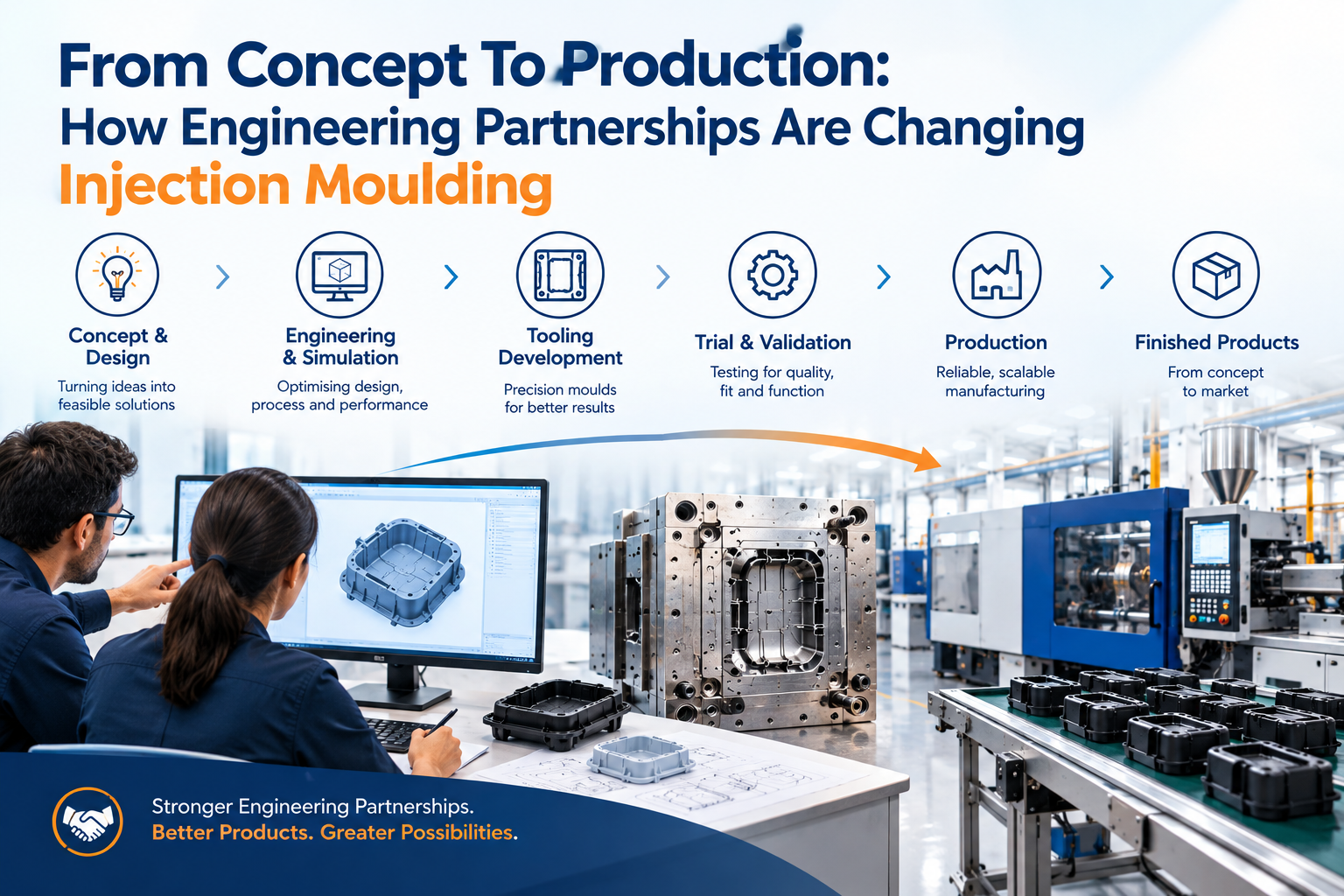
Injection moulding is often viewed as a straightforward manufacturing process: a customer provides a design, a mould is created, and components are produced.
But modern product development is changing that model.
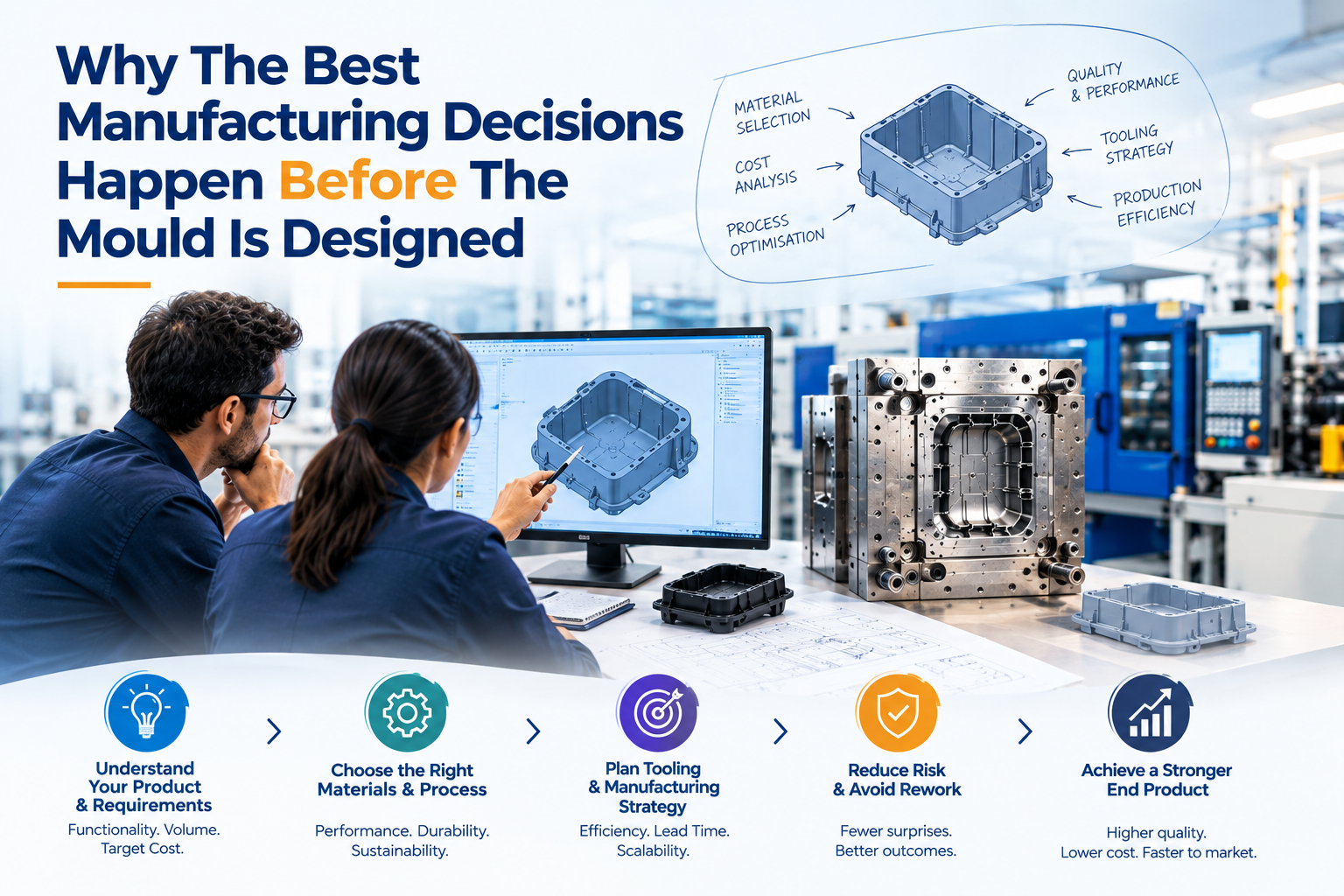
For OEMs building products where quality, precision, cost, scalability and time-to-market matter, manufacturing cannot begin only after the design is complete. The strongest outcomes often come from involving the manufacturing partner much earlier—when the product is still being developed.
This is where engineering partnerships are changing injection moulding.
For Atharva Polyplast, this engineering-led approach means looking beyond traditional production and becoming involved in the decisions that influence a component from concept to production.
Manufacturing Starts Before The Mould
A mould is not the beginning of the manufacturing journey.
The real journey starts with a product requirement.
At Atharva Polyplast, understanding the product requirement is an important starting point for developing an effective manufacturing solution. Engineering decisions can influence almost everything that follows: material selection, component geometry, tooling complexity, cycle time, dimensional stability, assembly and ultimately production cost.
An experienced engineering and manufacturing partner can identify potential challenges before they become expensive production problems.
Instead of simply asking, “Can we manufacture this?”, the better question becomes:
“How can we engineer this product for better manufacturability, performance and scalability?”
That shift changes the entire approach.
For OEMs working with Atharva Polyplast, early engineering discussions can help bring manufacturing considerations into the product-development process before tooling and production begin.
From Customer Drawing To Engineering Collaboration
Traditional manufacturing often follows a simple sequence:
Customer Drawing → Tooling → Production
An engineering-led approach looks very different:
Concept → DFM → Material → Tooling → Prototype → Validation → Production → Assembly
Each stage creates an opportunity to improve the product before the next stage begins.
Atharva Polyplast approaches injection moulding with the understanding that these stages are interconnected. A decision made during design can influence tooling, material behaviour, production efficiency and final component quality.
This collaborative approach allows manufacturers and OEMs to work together rather than treating manufacturing as the final step of product development.
- Concept: Start With The Product Requirement
Every successful component begins with a purpose.
Before discussing moulds and machines, engineers need to understand what the component needs to achieve.
What environment will it operate in?
What loads will it experience?
What are the dimensional requirements?
How will it interact with other components?
What production volumes are expected?
Understanding these requirements early helps establish the right direction for the product.
At Atharva Polyplast, considering these requirements early can help connect product expectations with practical injection moulding considerations.
The objective is to develop a manufacturing path that supports the application’s performance requirements as well as production requirements.
- DFM: Designing For Manufacturing
Design for Manufacturing, or DFM, is one of the most important stages in the entire process.
A component may look perfect on a CAD screen but still present significant manufacturing challenges.
Issues such as:
- Uneven wall thickness
- Insufficient draft angles
- Complex ribs
- Poor gate locations
- Potential warpage
- Difficult ejection
- Material shrinkage
- Tight and unnecessary tolerances
can create problems later.
Addressing these considerations before tooling begins can reduce redesigns, tooling modifications, production delays and quality issues.
At Atharva Polyplast, DFM considerations can help identify potential moulding challenges early and support practical design improvements before tooling investment.
Good moulding begins with good engineering.
- Material: More Than Just A Specification
Material selection can directly influence component performance and manufacturability.
The right material depends on factors such as:
- Mechanical requirements
- Temperature exposure
- Chemical resistance
- Dimensional stability
- Surface finish
- Application environment
- Regulatory requirements
- Production economics
An engineering partner can help evaluate these factors against the actual application rather than treating material selection as an isolated decision.
For Atharva Polyplast, material selection is part of understanding how the product requirement connects with the injection moulding process.
The material can influence shrinkage, processing behaviour, tooling requirements, cycle time and final component performance.
This makes material selection an important engineering discussion rather than simply a purchasing decision.
- Tooling: Turning Engineering Into Reality
Once the product design and material strategy are established, tooling brings the concept closer to production.
Tooling decisions can influence:
Quality. Cost. Cycle Time. Maintenance. Repeatability.
A well-engineered mould is not simply designed to produce one acceptable component.
It should be designed with repeatable, scalable production in mind.
At Atharva Polyplast, tooling is viewed as an important connection between engineering intent and production requirements.
Understanding component geometry, material behaviour, expected volumes and production requirements can help establish tooling solutions that support consistent manufacturing.
This is where experience in tooling and injection moulding becomes especially valuable.
- Prototype And Validation: Learn Before Scaling
Before moving into full-scale production, prototypes and initial trials provide valuable feedback.
Dimensions can be checked.
Material behaviour can be evaluated.
Functional requirements can be tested.
Potential design or tooling issues can be identified.
This stage creates an important opportunity:
Find the problem before production volume makes it expensive.
Validation transforms assumptions into evidence.
For Atharva Polyplast, prototype and validation stages provide an opportunity to evaluate whether the component, tooling and process are working together as expected before production is scaled.
This can help OEMs make informed decisions before committing to larger production volumes.
- Production: Engineering Meets Process Discipline
Once the component has been validated, production begins.
But consistent production requires more than having the right machine.
It requires controlled processes, trained people, quality systems, tooling discipline and continuous monitoring.
The goal is not simply to produce thousands or millions of components.
The goal is to produce them consistently, efficiently and within specification.
This is where the engineering work performed earlier connects directly with manufacturing execution.
At Atharva Polyplast, the objective is to carry engineering considerations into the production environment so that design intent and manufacturing requirements remain aligned.
Consistent injection moulding requires attention to process parameters, material behaviour, tooling performance and quality requirements.
- Assembly: Thinking Beyond The Individual Component
For many OEM products, the component is only one part of a larger system.
That means the manufacturing conversation should not necessarily end with injection moulding.
Assembly considerations can influence component design from the beginning.
How will the parts fit together?
Can assembly be simplified?
Can additional operations be reduced?
Can the component be designed for easier handling or integration?
Thinking about assembly earlier can help create a more efficient overall product-development process.
For Atharva Polyplast, looking beyond the individual moulded component creates an opportunity to understand how manufacturing decisions affect the complete product.
This broader perspective can help OEMs consider component design, tolerances and assembly requirements together.
Why This Partnership Matters To OEMs
The biggest advantage of an engineering partnership is not simply technical support.
It is earlier decision-making.
When engineering, tooling and manufacturing teams collaborate from the beginning, potential problems can be addressed while changes are still relatively easy to make.
That can contribute to:
Better manufacturability
Improved quality
More efficient tooling
Reduced development risk
Faster transition to production
Greater production scalability
The manufacturer becomes more than a production facility.
It becomes part of the product-development team.
This is the type of relationship Atharva Polyplast aims to build with OEM customers—one based on collaboration, engineering thinking and manufacturing expertise.
Rather than waiting for problems to appear during production, the objective is to identify opportunities and challenges earlier in the product lifecycle.
The Future Of Injection Moulding Is More Collaborative
As OEMs face increasing pressure to launch products faster, control costs and maintain consistent quality, the traditional separation between product development and manufacturing is becoming less effective.
The future belongs to partnerships where engineering and manufacturing expertise come together early.
For Atharva Polyplast, this means supporting OEMs beyond the conventional supplier role and contributing to the engineering and manufacturing journey.
The question is no longer simply:
“Who can manufacture this component?”
It is becoming:
“Who can help us engineer, validate and manufacture this product successfully?”
That is the shift from supplier to engineering partner.
And it is changing what injection moulding can deliver.
Building Long-Term OEM Partnerships
A successful OEM relationship is not necessarily based only on production capacity.
It is built through communication, technical understanding, consistent quality and the ability to solve manufacturing challenges.
Atharva Polyplast is focused on developing this kind of long-term engineering and manufacturing relationship with OEMs.
When an OEM and manufacturing partner collaborate from the early stages, both teams can develop a clearer understanding of the product requirements, manufacturing constraints and production objectives.
This can create a more connected path from product development to commercial production.
The result is a relationship where the manufacturer contributes more than machine capacity—it contributes knowledge and engineering experience.
Conclusion
Injection moulding will always depend on machines, materials, tooling and processes.
But the competitive advantage increasingly begins before the machine ever starts.
From Concept → DFM → Material → Tooling → Prototype → Validation → Production → Assembly, every stage presents an opportunity to make better engineering decisions.
For OEMs, choosing the right manufacturing partner is therefore about more than production capacity.
It is about finding a partner who understands the product, challenges the right decisions, solves problems early and stays involved from concept to production.
Atharva Polyplast is building its approach around this engineering-led way of working—helping customers move from product concepts to reliable, production-ready solutions.
With an emphasis on engineering collaboration, manufacturing expertise and practical problem-solving, Atharva Polyplast aims to support OEMs throughout the product lifecycle.
The goal is not simply to manufacture what has already been designed.
The goal is to help engineer what can be manufactured better.
For modern OEMs, that is the real value of an engineering partnership.
From concept to production, Atharva Polyplast is working toward a more collaborative future for injection moulding.
Connect With Us
Atharva Poly-Plast Ltd
W-163, S Block,
MIDC Bhosari,
Pune-411026
Email: info@atharvapolyplast.in
Phone: +91 94220 49184

Leave A Comment