
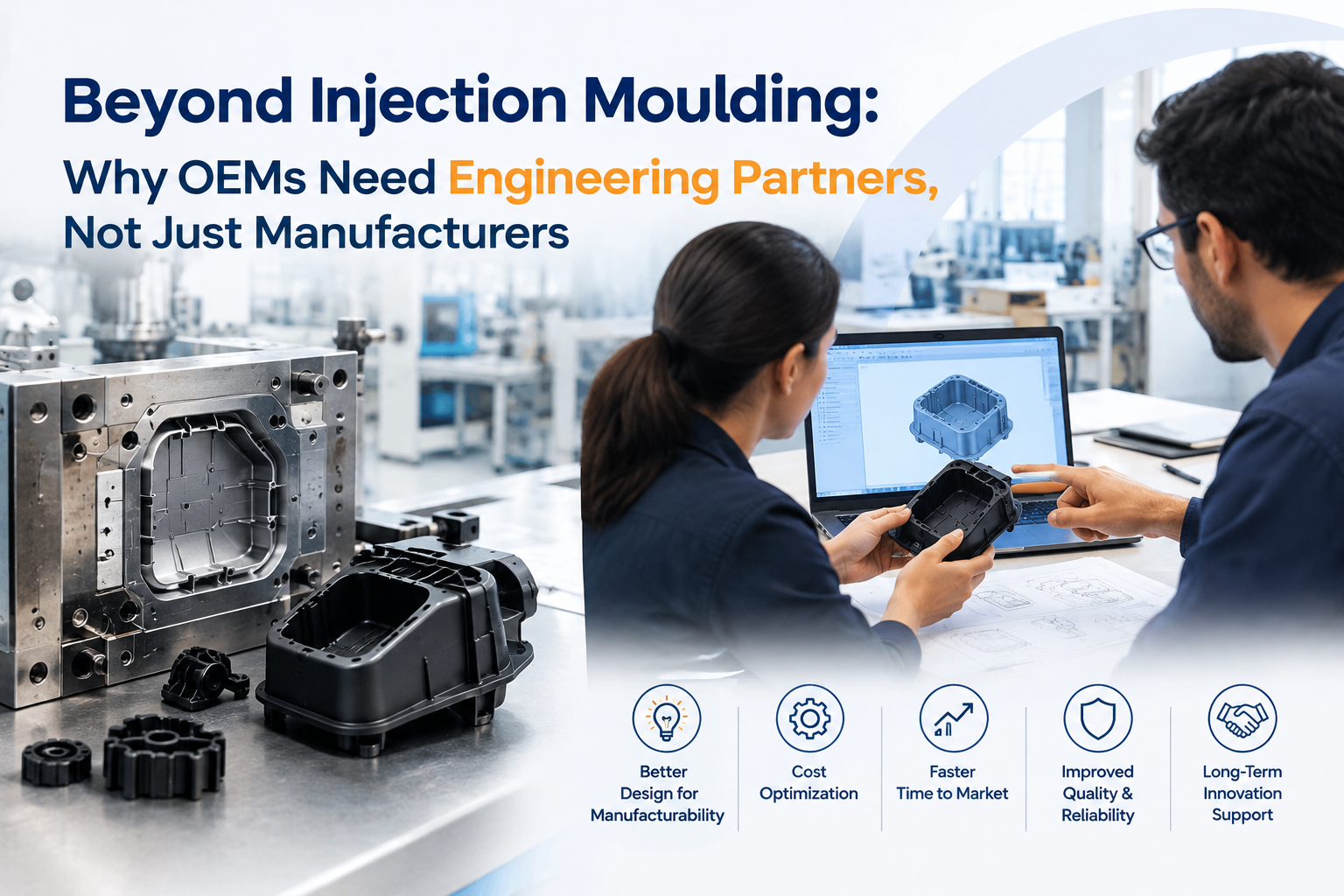
For decades, injection moulding has been viewed primarily as a manufacturing process: a customer provides a design, a mould is developed, components are produced, and the finished parts are delivered.
But modern OEM manufacturing is becoming more complex.
Product development cycles are shorter. Performance expectations are higher. Material choices are becoming more specialised. Quality requirements are stricter, and global OEMs increasingly expect suppliers to contribute more than production capacity.
This is where the role of an injection moulding company is changing.
The future belongs to manufacturers who can become engineering partners.
For companies such as Atharva Polyplast, this shift creates an opportunity to combine injection moulding expertise with engineering knowledge and manufacturing problem-solving capabilities.
Manufacturing Begins Before The Mould
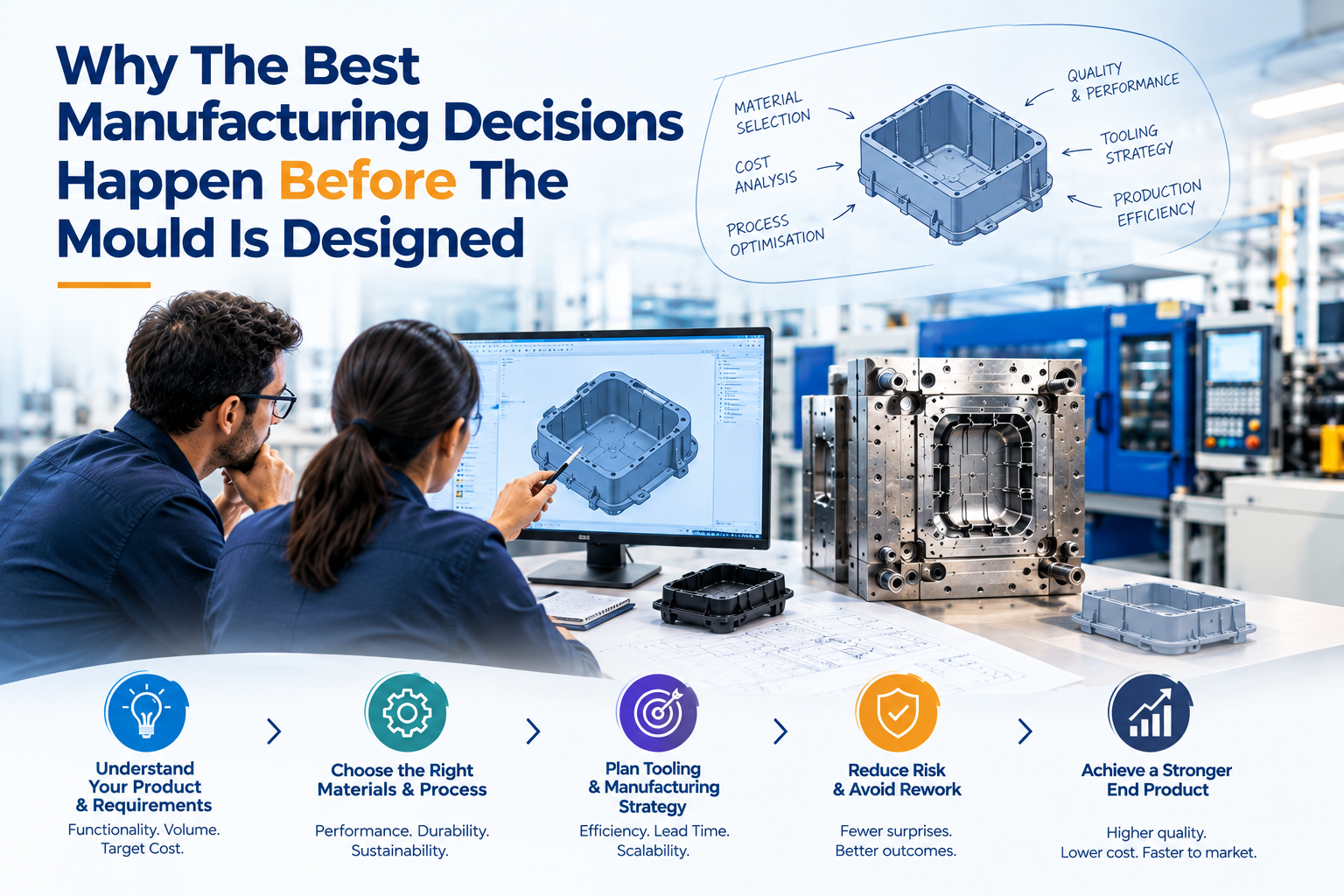
A component may enter production through an injection moulding machine, but its success is often determined much earlier.
Decisions made during the product-development stage can influence:
- Product performance
- Material behaviour
- Tooling complexity
- Manufacturing cost
- Dimensional accuracy
- Assembly
- Cycle time
- Quality
- Time-to-market
A manufacturer that becomes involved only after the design is finalised has limited influence over these decisions.
An engineering partner, however, can work with the OEM from the beginning.
This is the approach Atharva Polyplast aims to bring to OEM manufacturing—looking beyond production and contributing to the engineering decisions that influence the final component.
That means asking the right questions before the mould is even designed:
Can the component be manufactured efficiently?
Is the material appropriate for the application?
Will the geometry create moulding challenges?
Can the design be optimised for assembly?
Are there opportunities to reduce cost without compromising performance?
These conversations can make a significant difference to the final product.
From Concept To Production
At Atharva Polyplast, the opportunity lies in connecting engineering thinking with manufacturing execution.
The journey can involve multiple stages:
Concept → DFM → Material → Tooling → Prototype → Validation → Production → Assembly
Each stage influences the next.
- Concept
Every product begins with a requirement, application or idea.
Understanding the intended use, performance expectations and operating conditions allows engineering teams to identify manufacturing considerations early.
Early involvement can help OEMs understand potential manufacturing requirements before significant investments are made in tooling and production.
For an engineering-focused manufacturer like Atharva Polyplast, this early-stage collaboration can create a stronger foundation for the entire manufacturing process.
- Design For Manufacturing
Design For Manufacturing, or DFM, is where product design and manufacturing come together.
A well-designed component is not simply one that looks right on a drawing. It also needs to be practical to manufacture consistently.
Wall thickness, ribs, bosses, draft angles, parting lines, gates and other design elements can all affect moulding performance.
Identifying potential issues at this stage is generally far more effective than discovering them after tooling has already been developed.
A strong DFM approach can help Atharva Polyplast and its OEM customers identify potential manufacturing challenges early and make practical design decisions before production begins.
- Material Selection
The right polymer is not simply a matter of availability.
Application requirements such as strength, temperature resistance, dimensional stability, chemical exposure, surface finish and durability can influence material selection.
Engineering collaboration helps connect the product requirement with the manufacturing reality.
Material behaviour can also influence tooling, processing parameters, cycle time, component performance and long-term reliability.
By considering material selection as part of the engineering process, Atharva Polyplast can help OEMs approach polymer component development with both application and manufacturing requirements in mind.
- Tooling
Once the design and material are understood, tooling becomes the bridge between engineering intent and production.
Good tooling requires consideration of the component geometry, material behaviour, expected volumes, cycle requirements and quality expectations.
This is why tooling should be considered as part of the engineering process—not simply as a separate manufacturing step.
For Atharva Polyplast, tooling represents an important connection between product design and repeatable injection moulding production.
When tooling decisions are made with the complete manufacturing process in mind, OEMs can work toward improved consistency, productivity and component quality.
- Prototype & Validation
Before moving into full-scale production, prototypes and trials provide an opportunity to verify assumptions.
Dimensions, functionality, fit, appearance and process behaviour can be evaluated and refined.
This stage helps turn an engineered concept into a validated manufacturing solution.
Validation can also reveal opportunities for design improvements, material adjustments or process optimisation before full-scale production.
For OEMs working with Atharva Polyplast, this stage forms an important part of moving from an initial component concept toward a reliable production process.
- Production
Once the product and process are validated, production begins.
But engineering involvement doesn’t necessarily stop there.
Process consistency, quality control, productivity and continuous improvement remain important throughout the production lifecycle.
Injection moulding is not simply about producing large quantities of components. Consistent production requires control over process parameters, material behaviour, tooling performance and quality standards.
This combination of engineering and manufacturing thinking is increasingly important for OEMs looking for reliable long-term suppliers.
- Assembly
For many OEMs, the requirement doesn’t end with an individual moulded component.
Assembly considerations can influence component design, tolerances and manufacturing processes from the beginning.
Looking at the complete product journey allows manufacturers to identify opportunities beyond simply producing individual parts.
An engineering partner can consider how components interact with other parts, how they will be assembled and where design changes could simplify the overall product.
This broader perspective allows Atharva Polyplast to position itself not only as an injection moulding manufacturer, but as a potential engineering and manufacturing partner for OEM requirements.
Why OEMs Are Looking For More
Global OEMs are under constant pressure to improve quality, shorten development timelines and control costs.
They don’t simply need suppliers who can run machines.
They need partners who understand why the component exists, how it will be used and how it can be manufactured better.
This changes the relationship between an OEM and its manufacturing supplier.
Instead of:
“Here is our drawing. Manufacture it.”
The conversation becomes:
“Here is what we are trying to achieve. How can we engineer and manufacture it effectively?”
That difference is significant.
For Atharva Polyplast, this represents a shift from simply responding to manufacturing requirements toward participating in the engineering discussions that shape those requirements.
Engineering Partnership Can Reduce Problems Before They Start
Many manufacturing challenges become expensive when they are discovered late.
A design issue identified during the development stage can often be addressed before tooling investment, production trials and validation activities.
This is one of the biggest advantages of involving manufacturing expertise early.
The goal isn’t simply to fix problems faster.
The goal is to prevent avoidable problems from entering the manufacturing process in the first place.
That requires collaboration between product designers, engineers, tooling teams, quality teams and manufacturing specialists.
When these teams work together early, potential issues can be identified before they affect tooling, production schedules or product launches.
This is where an engineering-driven injection moulding company can provide value beyond production capacity.
The Shift From Supplier To Partner
The manufacturing industry is moving toward deeper collaboration.
OEMs increasingly value suppliers who can contribute engineering knowledge, manufacturing experience and problem-solving capabilities—not just production capacity.
For companies like Atharva Polyplast, this creates an opportunity to redefine what an injection moulding partner can be.
The ambition is not simply to manufacture a component after the engineering work is complete.
It is to participate in the journey that makes the component possible.
From concept to production.
From tooling to validation.
From component manufacturing to engineering partnership.
Because modern manufacturing is no longer just about making what is designed.
It is about helping design what can be made better.
Building Better OEM Manufacturing Partnerships
The relationship between OEMs and manufacturers is becoming increasingly collaborative.
Product designers want manufacturing feedback earlier. Engineers need practical input on materials and tooling. Procurement teams are looking for cost-effective solutions. Quality teams require consistency and traceability.
An experienced manufacturing partner can help bring these considerations together.
This is particularly important for complex polymer components where design, material, tooling and production decisions are closely connected.
The role of Atharva Polyplast is therefore not limited to operating injection moulding equipment. The larger opportunity is to support OEMs with a connected approach to engineering, tooling and manufacturing.
Why Early Engineering Collaboration Matters
Bringing an injection moulding partner into the project early can provide several advantages.
Better Design Decisions
Manufacturing feedback can help identify design features that may create production difficulties.
Improved Tooling Planning
Early understanding of geometry, material and production requirements can support more informed tooling decisions.
Cost Optimisation
Design and manufacturing discussions at an early stage can reveal opportunities to reduce unnecessary complexity and manufacturing costs.
Faster Development
Identifying potential issues before tooling and production can help reduce avoidable delays.
Consistent Production
A manufacturing process developed with engineering considerations in mind can provide a stronger foundation for repeatable production.
These advantages explain why OEMs are increasingly looking beyond traditional supplier relationships.
Conclusion
Injection moulding will always remain at the heart of polymer component manufacturing. But the role of the manufacturer is evolving.
The most valuable manufacturing partners are those who can bring engineering thinking into the process early—helping OEMs make better decisions around design, materials, tooling, validation, production and assembly.
That is the direction Atharva Polyplast is building toward: moving beyond the traditional manufacturer-supplier relationship and becoming a more capable engineering and manufacturing partner for OEMs.
For modern OEMs, the right manufacturing partner can contribute much more than production capacity. It can contribute experience, engineering insight, manufacturing knowledge and a problem-solving mindset throughout the product lifecycle.
The mould may be where production begins.
But engineering should begin much earlier.
Connect With Us
Atharva Polyplast Ltd
W-163, S Block,
MIDC Bhosari,
Pune-411026
Email: info@atharvapolyplast.in
Phone: +91 94220 49184

Leave A Comment